Virtual Minds
GEO vs SEO: how to get found inside AI answers
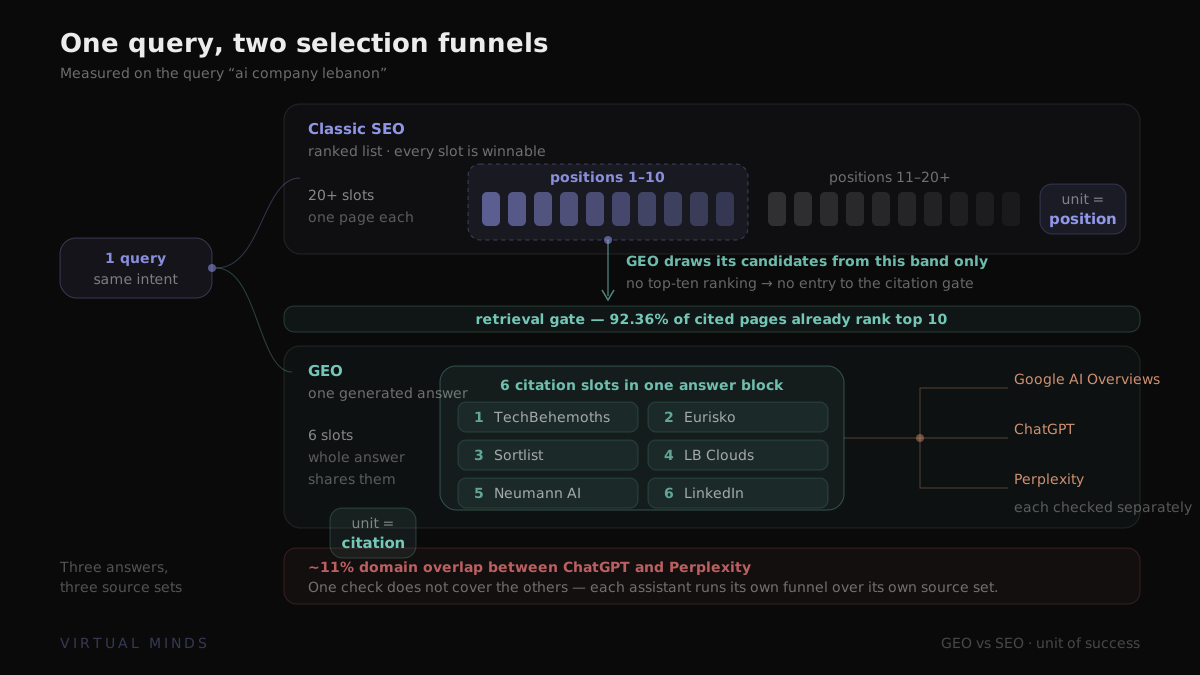
Classic SEO competes for a ranked link on a results page. Generative engine optimization (GEO) competes to be one of the handful of sources an AI assistant cites inside a generated answer. The two are stacked, not substituted — 92.36% of Google AI Overview citations come from pages already ranking in the organic top 10, which makes GEO a layer on top of SEO rather than a replacement for it.
If you are being told to choose between SEO and GEO, the choice is false. Below is the mechanism, and the measured numbers behind it: the SERP pulls are ours, run on 16 September 2026, published here rather than described. Below: what actually differs between the two, the six-versus-twenty number that makes the case, the structural work that changes citations, and how to measure any of it.
Generative engine optimization has measurable demand — the term, not the region
"Generative engine optimization" measures 4,400 searches a month in the US at keyword difficulty 54, and 18,100 a month globally (DataForSEO Google Ads, US, and Keywords Everywhere, global, September 2026). "Generative engine optimization" measures 4,400 searches a month in the US at keyword difficulty 54, and 18,100 a month globally (DataForSEO Google Ads, US, and Keywords Everywhere, global, September 2026). The commercial variants are softer and cheaper: "generative engine optimization service" measures 720/mo at difficulty 2, "generative engine optimization companies" 110/mo at difficulty 0, and "generative engine optimization tools" 720/mo at difficulty 32. Buyers who have not yet learned the word search "ai seo tools" instead — 2,400/mo in the US.
One correction to the regional pitch: the same term returns zero measured volume for the UAE. Demand for this capability is US and global English, not MENA. So the work is sold on the capability, not on a local search market that the data says is not there.
GEO vs SEO: the mechanism difference, row by row
The confusion is usually about the unit of success. SEO produces a position; GEO produces a citation. Everything else — what you measure, how fast it moves, what breaks it — follows from that one difference.
| Classic SEO | Generative engine optimization (GEO) | |
|---|---|---|
| What competes | A URL against every other URL for a query | A source against every other source for one generated answer |
| What wins | A ranked position in a list of twenty-plus | A cited slot in a set of a handful — six, on the Lebanon SERP we measured (DataForSEO, September 2026) |
| Unit of success | Position, then click-through | Citation presence, then share of answers |
| How you measure it | Rank tracking, impressions, clicks per query | Asking each assistant your buyers' questions and recording which domains come back |
| How fast it moves | Slow and roughly monotonic — index, then re-crawl | Irregular — answers regenerate per query and shift with model versions |
| What breaks it | Duplicate URLs, broken canonicals, thin pages, sitemap errors | Falling out of the top 10, inconsistent entity data, prose where a table belongs, and — on ChatGPT — being crowded out by low-quality sources it has not filtered |
| Prerequisite | A crawlable, indexable site | All of the above, plus a top-10 ranking |
That last row is the one vendors skip. ChatGPT cited synthetic or spam sites in 14.5% of cases against near zero for Google AI Overviews (figures carried in our MENA content strategy, September 2026), so "what breaks it" is not even the same across assistants.
Six citation slots against twenty-plus organic slots
We measured this rather than asserting it. On 16 September 2026 we pulled the live Lebanon SERP for "ai company lebanon". The Google AI Overview cited exactly six sources: TechBehemoths, Eurisko, Sortlist, LB Clouds, Neumann AI, and a LinkedIn page for Beirut AI, a local AI community rather than a vendor. The organic result set for the same query ran past twenty positions — we recorded ranked results out to #21, Sortlist (DataForSEO SERP pull, Lebanon, September 2026, ours).
Six slots against twenty-plus. That ratio is the argument for GEO in one number: six cited sources sit above a page that ran to at least twenty-one organic positions on the query we measured, and it sits above everything on screen. The same pull showed an AI Overview, People Also Ask, a local pack, related searches and Google reviews all present — the answer layer is already live on commercial B2B queries in this market, not a 2027 forecast.
Top-10 ranking is the price of entry
92.36% of Google AI Overview citations come from pages already ranking in the organic top 10 (third-party study carried in our content strategy, September 2026). A page that does not rank is, with rare exceptions, not eligible to be cited. Top-10 ranking is the price of entry, and no amount of answer-shaped formatting buys a way around it.
Our own pull reproduces the pattern. Five of the six cited domains also appear in the organic results for the same query or a close variant: TechBehemoths at #7 organic and #1 on "best ai companies in lebanon"; Eurisko at #13 and #8; Sortlist at #21 and #11 (DataForSEO SERP pulls, Lebanon, September 2026, ours). None of that tells us what those companies did to get cited — being cited without running a GEO program at all is the honest reading, and the more interesting one. Eurisko ranks #13 on "ai company lebanon" and #8 on "best ai companies in lebanon" — above us on both, and theirs is the vendor page we study (DataForSEO SERP pulls, Lebanon, September 2026, ours).
Three assistants, three separate checks
Only about 11% of cited domains are cited by both ChatGPT and Perplexity (figure carried in our content strategy, September 2026). They are separate systems with separate source sets, so one visibility check covers neither the other, and neither covers Google AI Overviews.
The evidence is also genuinely unsettled in one place. Two studies disagree on whether ChatGPT favours vendor-owned domains — 25% in one, 74.6% in the other, likely a model-version change between March and June 2026. We do not resolve that by picking the flattering side. The recommendation that survives either reading: build owned depth and third-party presence at the same time.
Directory weight deserves the same care. The G2 network accounts for 8.0% of citations while independent content plus vendor self-citation accounts for 79% — and our measured Lebanon SERP splits the same way: of the six cited sources, two are directories (TechBehemoths and Sortlist), three are vendor sites (Eurisko, LB Clouds and Neumann AI), and one is a LinkedIn page for Beirut AI, a local AI community. Directories own the organic page, and they took two of the six citations we measured. Your own pages are the part you control.
The structural work that actually changes citations
These are the rules we write to, which is why we can recommend them specifically. None of them is a trick.
- Answer-first sentences. Open every page and every FAQ with a complete, standalone answer in two to three sentences. Assistants extract sentence one.
- Tables instead of prose for any comparison. Structured content is lifted into generated answers far more readily than a paragraph making the same point.
- One H1, clean H2/H3 nesting, 120–180 words between headings, 40–60 word lead paragraphs. Headings that say what the section does.
- Five to eight answer-first FAQs per pillar page, emitting
FAQPageschema. - Entity consistency — one name, one address, one description, one
Organizationblock across every property a model reads. This is a named deliverable in our GEO line, not a borrowed tip. - Real alt text plus
ImageObjectschema on every image. Our own legacy blog traffic arrives largely from Google Images, which is why this is a standing rule here rather than a general tip.
One honest caveat about our own implementation. Until this week a post on this blog would self-canonicalise at any fabricated URL path, and our sitemap advertised URLs that returned 404 — both now fixed, along with the FAQPage markup the FAQs below emit. The sitemap still needs a pass. We fix prerequisites before claiming technical hygiene as a credential. That is the same order of work we would run on a client site — prerequisites first, citations second.
Why a zero-volume query can still be worth winning
The Lebanon B2B head terms have no measurable search volume at all. "ai company lebanon", "ai development company lebanon", "ai agency beirut" and "lead generation company lebanon" all return null in-country (DataForSEO, Lebanon, September 2026). What does carry volume there is older demand: digital marketing agency lebanon 390/mo, software company lebanon 320, web development company lebanon 140, seo company lebanon 70.
A zero-volume query with an AI Overview is still worth the work. The unit of success in GEO is the citation set, not the search volume feeding it. The traffic implication has to be stated plainly: a null-volume query sends no traffic. It sends the one buyer who asked, at the moment they were choosing a vendor. The People Also Ask box on that query asked "What are the 7 big AI companies?" and "Who are the big 3 AI companies?" — all global brand questions, which is evidence there is no settled local answer set for an assistant to draw on yet.
Directional support for the spend, with its caveat attached: 51% of B2B buyers now start software research with AI, 69% chose a different vendor than planned based on AI guidance, and one-third bought from a vendor they had never heard of (G2 Buyer Behavior 2026). G2's sample is NA/EMEA/APAC with no MENA cut, so treat those as direction, not local fact.
What we do with this, and what you can ask us for
The SERP data in this post was produced by the same harness we sell as GEO & AI Visibility, a capability line on Cortex — the AI business operating system we run Virtual Minds on, currently testing with design partners. We are our own first customer here: the Lebanon pulls above were run for our own positioning before they were run for anyone else's. Four deliverables, no more: an answer-share audit across the major assistants; GEO of site content and structured data; entity and knowledge-graph consistency across the properties models read; and ongoing visibility tracking with month-over-month movement. GEO & AI Visibility is delivered with 99Visibility, our delivery partner in Lebanon.
For related reading: the same SERP pulls underpin our breakdown of who actually ranks among AI companies in Lebanon in 2026, and the cost side of the adjacent capability is in what AI lead generation costs in Lebanon and the GCC. If you want the operations view instead, we wrote up how we run our own outbound on our own system.
If you want to know which six sources an assistant cites for the query your buyers actually type, send us the query and we will run the audit and show you ours.
Frequently asked questions
What is generative engine optimization (GEO)?
GEO is the work of getting your pages used as a cited source inside an AI-generated answer, rather than ranked as a blue link below it. The term itself now carries real demand: "generative engine optimization" measures 4,400 searches a month in the US and 18,100 globally (DataForSEO Google Ads, US, and Keywords Everywhere, global, September 2026). The work covers content structure, structured data, and consistent entity information across the properties models read.
Does GEO replace SEO?
No. 92.36% of Google AI Overview citations come from pages already ranking in the organic top 10 (third-party study carried in our content strategy, September 2026), so a page that does not rank is mostly not eligible to be cited. GEO sits on top of classic SEO. Any vendor selling GEO as a replacement for SEO is selling something the citation data contradicts.
How many sources does an AI Overview actually cite?
Six, on the query we measured. For "ai company lebanon" in Lebanon, the Google AI Overview cited exactly six sources — TechBehemoths, Eurisko, Sortlist, LB Clouds, Neumann AI and LinkedIn — while the organic result set ran past twenty positions (DataForSEO SERP pull, Lebanon, September 2026, ours). Six citation slots against twenty-plus organic slots is the whole argument for GEO in one number.
How do I know if AI assistants are citing my business?
You check each assistant separately: ask the questions your buyers ask, and record which domains come back. Only about 11% of cited domains are cited by both ChatGPT and Perplexity (figure carried in our content strategy, September 2026), so a check on one tells you nothing about the other. That per-assistant check is the answer-share audit in our GEO & AI Visibility line.
What content format gets cited most?
Comparisons at evaluation stage, at 42% of citations. Listicles take 50% at consideration, how-to guides 34% at awareness, and pricing guides 30% at decision (BeVisible IQ, 2,020 citations, March 2026). Separately, 70.8% of B2B AI citations are "best"/"top" lineups, over half carrying "2026" in the title (Overthink Group, 1,260 prompts, June 2026).
How long does GEO take to show results?
No defensible timeline exists, and we do not publish one. Nobody has a dataset that supports "cited in 30 days", so a vendor quoting one is guessing in public. What we report instead is month-over-month movement in tracked visibility per assistant — the same instrument on the same questions, repeated, so a change is readable rather than asserted.
Does GEO work in markets with no search volume?
Yes, and Lebanon is the case. "ai company lebanon" returns null measured volume in-country (DataForSEO, Lebanon, September 2026) yet still produces an AI Overview with six citation slots. Volume is the wrong unit for GEO. Be honest about the consequence: a zero-volume query sends no traffic, it sends the one buyer who asked the question.