Virtual Minds
What AI lead generation costs in Lebanon and the GCC

AI lead generation cost is driven by two inputs: how many contacts you touch and how many channels you run. Everything else — software seats, sending infrastructure, the model calls — is smaller than buyers expect, and list quality is larger. Clutch publishes hourly bands of $25–149/hr for Lebanese providers (Clutch, Lebanon listings), which is the only public price anchor in this market, and it predicts almost nothing about your bill.
You are trying to budget a line item that no vendor in Lebanon publishes a price for. This post gives you the cost structure instead of a number: the five drivers that actually move the bill, a table comparing an in-house hire against per-seat tools against an operated service, and the four funnel metrics to demand from any provider before you sign. We do not publish our own rates, and the last section says why.
What is publicly known about price here
Two figures exist in public, and both are context rather than quotes. Clutch lists 26 AI companies for Lebanon and publishes hourly-rate bands of $25–149/hr across Lebanese service providers. That band covers software development, design and marketing work; it is not a lead-generation rate, and no provider in it is quoting you outbound.
The second figure is labour. Lebanon's tech sector has largely dollarized, and engineers run roughly $1,000–3,500/month (Virtual Minds MENA B2B Content Strategy §3, September 2026 — sector context, not a services rate and not a margin calculation). It matters because an in-house outbound hire is priced against that market, not against a software licence.
What does not exist: a single published price page from a Lebanese lead generation provider. We checked the live first page. Nobody publishes pricing, comparison tables or regulation explainers, and the deepest vendor page in the market — Eurisko's — offers industry depth, feature explainers, an FAQ and a "Book A Call", with no figures.
The five cost drivers to model
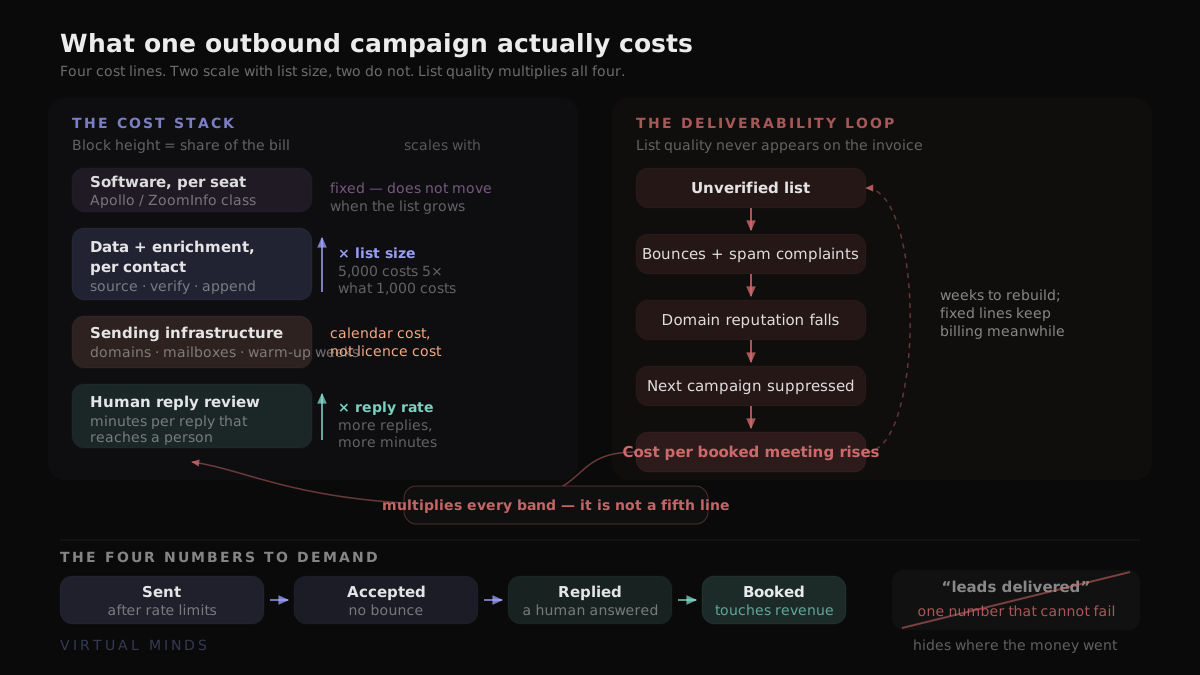
Model these separately. A single blended monthly figure hides which of them will grow when you scale, and only two of them do.
1. Data and enrichment — priced per contact
Sourcing, validation and enrichment are three distinct steps, and each is billed against the number of contacts that pass through it. Double the list, and this line doubles. It is the only line in the stack that tracks volume one-for-one, which makes it the line that decides whether a wider ICP is affordable.
Validation deserves its own budget row. An email that was correct nine months ago is a bounce today, and a bounce costs more than the record. We hold a 95%+ email accuracy target on validated records — a target we design against, not a measured published result.
2. Software — priced per seat, not per contact
Per-seat data subscriptions, the Apollo/ZoomInfo class, price by headcount and annual commitment. They do not scale with list size, which is why they look cheap on a spreadsheet and then fail the second question: the exports and the enrichment history sit inside someone else's account, and they leave when the seat does.
We took the other path. LeadsMind replaces per-seat subscriptions with owned technology and owned data, which changes who holds the list at the end of the term rather than just the shape of the monthly line.
3. Sending infrastructure — priced in calendar time
Domains and mailboxes are cheap. Reputation is not. A new sending domain cannot open at volume; send rate rises over weeks before a campaign runs at its intended rate, and that delay is the real cost — weeks before the first reply, not a licence fee. It is also the line most often missing from a plan, because it does not appear on any invoice. Our own campaign sender is rate-limited by design and records bounces and failures per campaign for exactly this reason.
4. Human review on replies — the line buyers omit
Every reply that reaches a person costs minutes. A referral, an objection and an out-of-office all need triage before routing. This means a higher reply rate raises your cost, which is the correct direction: you are paying for conversations, and conversations are the product. Budget it as a headcount fraction rather than a rounding error. We have no published minutes-per-reply figure, so treat the direction as our reasoning, not a benchmark.
5. The cost of a bad list — a multiplier, not a line
The expensive part of a bad list is not the money spent on the list. Bounces and spam complaints degrade the sending domain's reputation, which suppresses the next campaign that had nothing wrong with it, and reputation takes weeks to rebuild. That is why list quality dominates software price in the total: software is a line item, list quality multiplies every other line. This mechanism is our operating reasoning, not a published measurement.
Three shapes: in-house, per-seat tools, operated service
Compare the shapes before the numbers. The five questions below decide the total cost of an outbound function over two years more reliably than any monthly figure, and four of them are not about money at all.
| Question | In-house hire | Per-seat tools | Operated service |
|---|---|---|---|
| Setup time before the first send | Hiring cycle, then domain warm-up in weeks | Days to buy, then domain warm-up in weeks | Scoping, then domain warm-up in weeks |
| Monthly cost shape | Fixed — salary, benchmarked against the local engineering market | Fixed per seat, plus per-credit data on top | Tracks volume and channel count |
| Who owns the list and enrichment | You | The vendor account; exports leave with the seat | Depends on the contract — ask before signing |
| What happens when someone leaves | The capability stops until you rehire | The seat and its export history go with them | Continues; the risk shifts to provider concentration |
| Where the risk sits | Single point of failure in one person | Renewal pricing and data freshness | Provider dependency and contract exit terms |
None of these is universally cheaper. An in-house hire is the right answer when outbound is your core motion and you can keep one person busy year-round; per-seat tools suit a team that already knows its list; an operated service suits a company that needs the funnel running before it can justify the headcount. We compare the same three shapes in more depth in in-house AI team versus an operated AI system.
The four numbers to demand from any provider
Ask for the funnel: sent → accepted → replied → booked. Four stages, reported monthly, with bounce rate beside them.
- Sent — volume that actually left, after rate limits and suppression.
- Accepted — delivered and accepted by the receiving server. The first place a bad list shows up.
- Replied — human responses, positive and negative. Negatives are data.
- Booked — meetings on a calendar. The only stage that pays for the rest.
A provider who reports only "leads delivered" has given you the one number that cannot fail. It cannot distinguish a list that bounced from a list that converted, and it cannot tell you which stage to fix. Our own sender instruments sent, delivered, opened, clicked, bounced and failed counts per campaign — we run our own outbound on this system and read the same four stages our clients do, which is described in how we run outbound on our own system.
Selling from Lebanon into the GCC
The common shape is a Lebanese delivery base selling into the Gulf, and it is how Webspot positions itself — credit to them for solving the positioning question early. What changes at the border is obligation, not cost structure. Saudi Arabia's SDAIA AI Adoption Framework was published in November 2025 and sets mandatory governance across five pillars; Saudi PDPL is in live enforcement with 48 formal decisions across 2025–26. The UAE federal PDPL's executive regulations remain unissued as of 2026, with DIFC and ADGM carved out under their own regimes. Lebanon has no national AI strategy and no AI-specific regulation, and Law 81/2018 is not a comprehensive data-protection regime (Virtual Minds MENA B2B Content Strategy §3, September 2026). Budget legal review per market, once, rather than assuming one posture covers both sides.
Why you cannot size this market with a keyword tool
"Lead generation company lebanon" returns null in-country volume on DataForSEO Google Ads and 0 global on Keywords Everywhere (September 2026). Null means Google Ads reports no reliable volume, not "a little". Meanwhile "digital marketing agency lebanon" returns 390/mo and "software company lebanon" 320/mo (DataForSEO, Lebanon, September 2026) — buyers here search the adjacent category. The capability demand sits in English-language global search: "ai lead generation" 1,600/mo and "apollo alternative" 390/mo (DataForSEO, US, September 2026).
Absence of measured search volume is not absence of demand; it means the tool cannot size this market and your budget should be built against a list of named accounts instead. The live first page says the same thing about competition: on "ai lead generation company lebanon" (DataForSEO, Lebanon, September 2026), Think Unlimited holds #2, Sulsaly #3, L'Atelier Growth #6, Webspot #7 and ZIXOU #10 — with Sortlist, The Manifest, TechBehemoths and Entasher taking four of the top eleven. We do not appear on that page at all. They are the incumbents on the exact search this post targets, and we are not yet on it. For the wider picture of who is actually visible in the Lebanese market, see the best AI companies in Lebanon, and for why the citation layer matters more than the ranking, GEO versus SEO.
What we do, and what it costs
Lead Generation & Outreach runs on Cortex, the AI business operating system we run Virtual Minds on — currently testing with design partners. The line covers ICP definition and sourcing across LinkedIn, Sales Navigator and web; AI validation and enrichment against a 95%+ email accuracy target; ML lead scoring; sequences across email, LinkedIn and WhatsApp with reply routing; and funnel reporting on the four stages above. LeadsMind powers it, and is launching in Lebanon and the UAE.
We do not publish a price, because scope decides it and a number without a scope is marketing. Tell us the account list, the markets and the channels, and we will scope it. Reply and we'll show you ours — the same funnel, on the same system, before you commit to anything.
Frequently asked questions
Why don't you publish your prices?
Scope drives the number, and a number without a scope is marketing. Five things move it: how many named accounts are on the list, how many markets you sell into, how many channels run (email only, or email plus LinkedIn plus WhatsApp), whether we handle the replies or your team does, and whether a dashboard is in scope. A published figure that ignores all five would be wrong for almost every reader. Book a call and we will scope it and give you a number you can hold us to.
What does AI lead generation actually cost in Lebanon?
The public market context is Clutch's published hourly bands for Lebanese providers, $25–149/hr (Clutch, Lebanon listings), and a dollarized tech sector where engineers run roughly $1,000–3,500/month (Virtual Minds MENA B2B Content Strategy §3, September 2026 — sector context, not a services rate). Neither number predicts your bill. The cost is driven by list size and channel count, because data and enrichment price per contact while software prices per seat. Only one of those scales when you double the list.
Is it cheaper to hire someone in-house or use an operated service?
The honest answer is about shape, not price. In-house is a fixed monthly cost, the data and the domain reputation stay with you, and the whole capability stops when the person leaves. Per-seat tools cost by headcount, and the exports leave with the seat. An operated service tracks volume, and the question to ask before signing is who holds the list and the sending domains at the end of the term. The comparison table above sets the five questions side by side.
What should a lead generation provider report to me?
Four stages: sent, accepted, replied, booked. Ask for bounce rate alongside them. A provider reporting only "leads delivered" has handed you a number that cannot fail — it cannot distinguish a list that bounced from a list that converted, and it cannot tell you which stage to fix. If the four stages are not in the report, they are not being measured.
Why is list quality more expensive than software?
Because a bad list costs more than the list. Bounces and spam complaints degrade the sending domain's reputation, which suppresses the next campaign that had nothing wrong with it, and reputation takes weeks to rebuild. This is our operating reasoning rather than a published benchmark. Software price is a line item you can read off an invoice; list quality is a multiplier on every other line.
Do I need to warm up new domains, and what does that cost in time?
Yes. New domains and mailboxes cannot start at volume; sending rises over weeks before a campaign runs at its intended rate. The cost is calendar time before the first reply, not a licence fee, and it is the item most often missing from a plan. Our own campaign sender is rate-limited by design and counts bounces and failures per campaign for the same reason.
What is LeadsMind and how is it different from buying Apollo or ZoomInfo seats?
LeadsMind sources, validates, enriches and scores prospects, then runs sequences across email, LinkedIn and WhatsApp with reply routing, and reports sent, accepted, replied and booked. It is launching in Lebanon and the UAE. The structural difference is per-seat data subscriptions versus owned technology and owned data — which changes who holds the list when the contract ends, not just what the monthly line says.
How do I size this market before I budget for it?
Not with a keyword tool. "Lead generation company lebanon" returns null in-country volume on DataForSEO and 0 global on Keywords Everywhere (September 2026), while "digital marketing agency lebanon" returns 390/mo. Buyers here search the adjacent category. Measured absence of search volume is not absence of demand — it means the keyword tool cannot size this market. Budget against your own list of named accounts instead.