 Virtual Minds
Our Story · Abu Dhabi, since 2022
Why can't ordinary people use the most powerful technology in the world?
Since 2022, Virtual Minds has asked that same question in five different rooms, on five different technologies. The answers changed every eighteen months. The question never moved an inch.
Four years·Five technologies·One question
Make it fun
Mobile games · 2022–2023
We started by shipping games. Five of them. Puzzles, drift racing, idle empires. Nothing about it looked like the future.
It was the best possible apprenticeship. Games are the most unforgiving product category on earth — nobody is contractually obliged to open one twice. You learn, very fast, that the difference between a thing people use and a thing people abandon has almost nothing to do with how clever it is.
Doran Stickman
Published — iOS + Android
2022–23
Match n' Merge 3D
Published — iOS + Android
2022–23
Thumb Drift
Published — iOS + Android
2022–23
Memory Maze Dash
Published — iOS + Android
2022–23
Galaxy Tycoon
Published — iOS + Android
2022–23
What we learned
Technology nobody uses is worth nothing, however advanced it is.
Make it human
Virtual worlds & Virtual Me · 2023
Then we built worlds — a fashion tower for North Fashion on Decentraland that hit third on trending places, with an NFT gallery and French DJs on the roof. We also put an AI receptionist at the door. Nobody asked for it. We built it because we'd walked through our own building and noticed the problem: it was beautiful, and there was no one to talk to.
That receptionist is the origin of everything that followed. Within months we had dropped the buildings and kept the character. Virtual Me was a companion you could design, furnish a room for, and actually talk to — GPT-4 for the mind, a customisable 3D body, a voice. In the May 2023 business plan we wrote a sentence we have been rewriting ever since:
“Bridging the gap between humans and AI, making technology more personal and relatable.”
Virtual Me
3D AI companion — GPT-4, Ready Player Me
2023
What we learned
The interface isn't the screen. It's the relationship.
Make it real
AI characters for institutions · 2023–2024
Then the region called, and the stakes changed. We built Ahmad and Nour — the faces of TII's Falcon and Noor language models — and took them to GITEX and Web Summit Lisbon. We built an AI replica of Sultan Al Neyadi, the first Arab astronaut to walk in space, running on Falcon 180B, and presented it to the office of Sheikh Khaled bin Mohammad bin Zayed Al Nahyan. We built a Jeff Bezos AI character that drew a crowd at AWS Cloud Day UAE.
We built for First Abu Dhabi Bank, Saudi National Bank, Spinneys, and Emeritus, whose learning worlds trained Unilever's people. The realities were what we delivered. The intelligence was what mattered — and we were spending most of our budget on the part of the product nobody remembered.
What we learned
This region will buy ambitious AI — but only from people who ship. And the 3D shell was the least valuable thing we made.
Make it simple
Consumer AI apps · 2024–2025
So we threw away the shell. If only 2% of people used AI daily, the bottleneck was never capability. It was friction — five subscriptions, a prompt you have to learn, an hour you don't have. We started building small, sharp apps that each did exactly one useful thing with no tutorial at all.
Half a million people used something we made. We had our proof: we can take a frontier model and turn it into something a stranger will pay for on a Tuesday.
Room AI
#1 AI interior design app, US
2025
Headshot AI
#1 AI headshot app, US · +450%
2025
What we learned
We can productise AI. We cannot outspend Google for a stranger's attention.
Make it work
Production AI for business · 2025–today
In 2025 we walked away from two #1 apps. Not because they failed — because we could see the ceiling from where we stood. We took the capability we'd proven on consumers and pointed it at businesses, where the customer pays a hundred times more and stays six times longer, and where almost nobody can actually deliver.
The tools we'd built to run our own portfolio already had names: Cortex, the AI engine. Synapse, the data layer. Today the Cortex is a brain-inspired operating system — organisational knowledge, market expertise, and autonomous AI departments in one programmable layer. Our products are clients of it.
And Virtual Minds runs on it. Founders and AI departments operating at 70–80% autonomy is not a diagram in a deck. It is our Tuesday. We are our own first customer, and the proof of the product is the company.
LeadsMind
UAE B2B lead generation
2026
InsureMind
Digital insurance
2026
What we learned
The last mile is the whole business.
Five answers. Five constants.
What never moved
We remove friction.
Not cost, not ignorance — friction. The gap between what a technology can do and what a person can actually get it to do. We've been closing it since our first game.
We build here.
ADGM-registered since the beginning, Al Maryah Island, Abu Dhabi. Arabic and English as a starting condition, not a localisation ticket.
We think in minds.
Cortex. Synapse. Every product is named [Something]Mind. The metaphor turned out to be true: what we build are nervous systems.
We use it before we sell it.
The Cortex ran Virtual Minds before it ran anybody else. If we won't stake our own operations on it, we won't invoice you for it.
We run two workforces.
A young, talented, human team — working alongside AI agents that don't sleep. Humans decide, agents execute, and nothing ships without a human name on it.
Proof, not promises
The record so far
500,000+
people used something we made
2× #1
Room AI & Headshot AI, top of their US categories
+215%
revenue growth in a single quarter
5
published games before most teams ship one product
TII · First Abu Dhabi Bank · Saudi National Bank · AWS Cloud Day UAE · Emeritus · Spinneys · GITEX · Web Summit Lisbon
Technologies
The tools already had names
Cortex
Runs Virtual Minds todayThe AI engine. Organisational knowledge, market expertise and autonomous AI departments in one programmable layer.
Synapse
The data and API layer. Connects every product to the Cortex.
Flow
The experience engine — the interface layer our apps are built on.
Echo
Insights and optimisation. Measures what shipped, feeds it back.
Aura
The design and brand system.
Team
Four operating founders
Every founder runs a function, and every function runs on the Cortex.
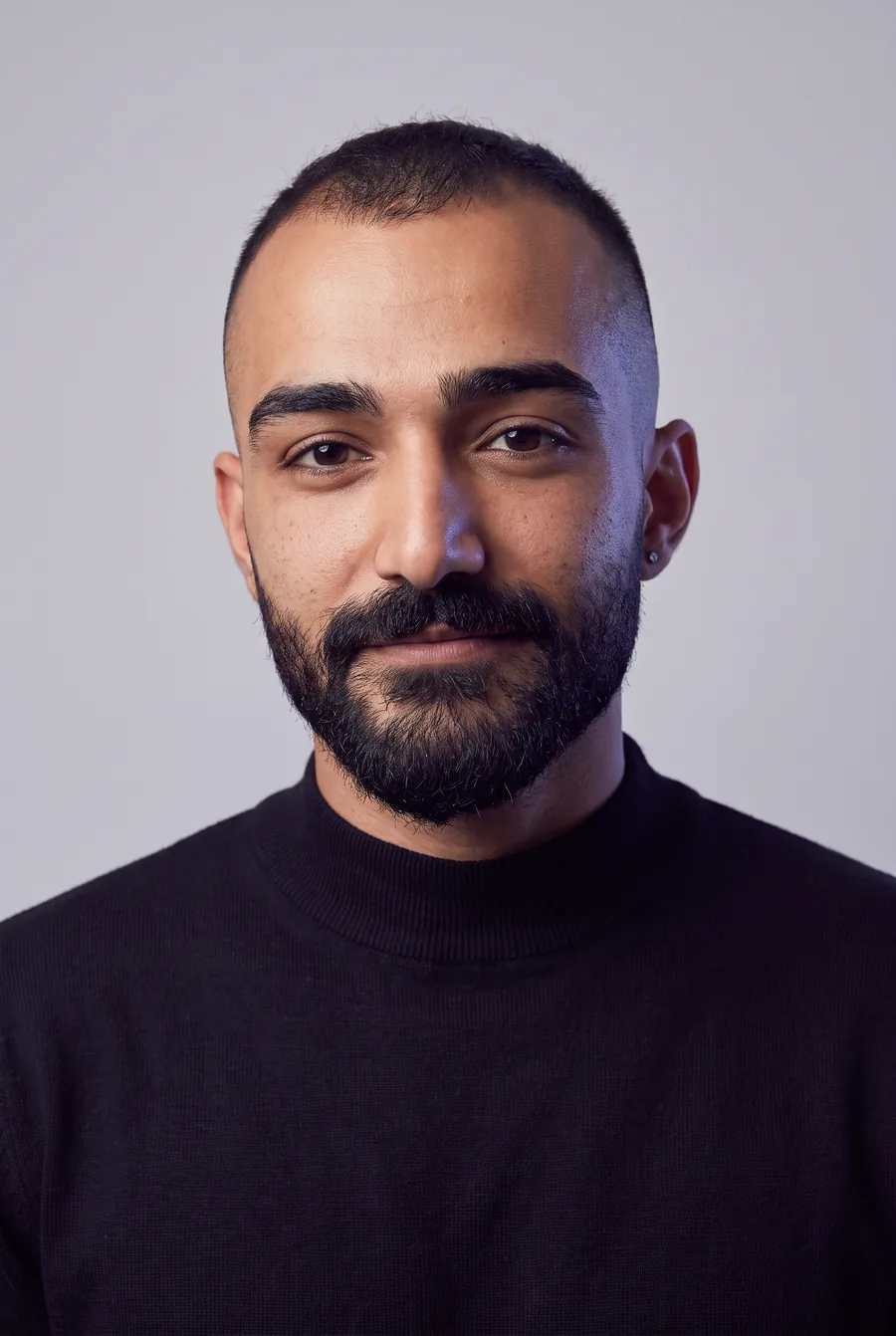
Liwaa Beaini
Product & Marketing
Drives product vision, design system, and go-to-market strategy across the portfolio.
LinkedIn
Khayal Hassanieh
Engineering
Owns infrastructure, deployment pipelines, platform security, and the Cortex architecture.
LinkedIn
Saeed Hamzeh
AI & Data
Leads AI orchestration, data pipelines, model operations, and MCP tool development.
LinkedIn
Bahaa Atallah
Finance & Operations
Manages QA, customer success, pricing strategy, and financial operations.
LinkedInAnd the team building alongside them
Dana Ghanem
Social Media Manager
Ammar Thebian
Digital Marketing Intern
Where we stand
We build production systems — not prototypes.
Big labs build the engines. We build the last mile to a human being. That has been the work for four years — through games, worlds, avatars and apps — and it is the work now.