Virtual Minds
Building an in-house AI team vs running an operated AI system
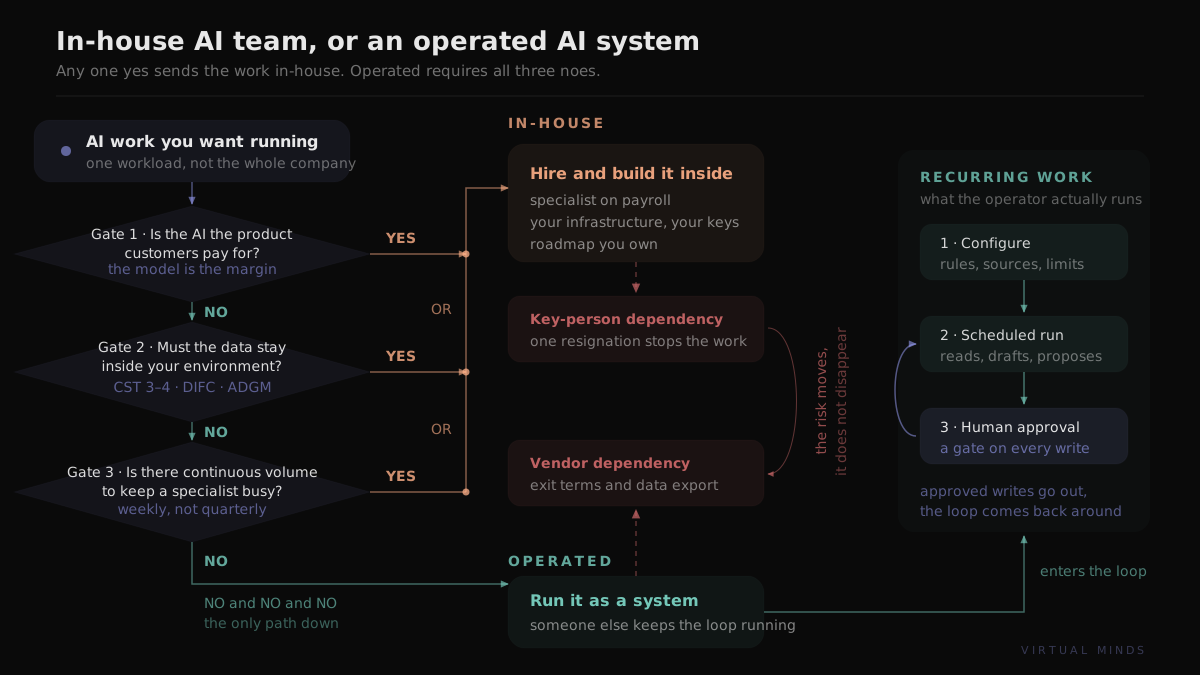
Build in-house when AI is the product you sell, when domain data cannot leave your environment, or when there is enough continuous volume to keep a specialist occupied. Run an operated system when AI supports the business rather than being it, when there is no existing ML function for a hire to attach to, and when the work is recurring rather than novel. Cost is the wrong first question, because no published comparison of the two — ours included — measures them against each other.
A shortlist of AI work, and a board question about whether to hire for it. This post gives you the six dimensions the decision actually turns on, an honest table across both routes, and the cases where each one wins outright. It runs in five parts: the decision rule, the comparison table, where in-house wins, where operated wins, and what Lebanon specifically changes.
The decision rule, before the table
One test separates the two routes more reliably than any cost model: is the AI work recurring or novel?
Recurring work has a shape that repeats — the same visibility check each month, the same enrichment on each new list, the same report assembled from the same systems. A running system does it and a person approves the writes. Novel work has no shape yet: somebody has to invent the model, the evaluation setup and the data pipeline, and that somebody has to be in the room when it breaks at two in the morning.
The second test is ownership of the problem. If the AI is what your customers pay for, the capability belongs inside the company whatever it costs to keep there. If the AI makes your existing business cheaper to run, it is infrastructure, and infrastructure is routinely operated by someone else.
Six dimensions, both routes
Prices, salaries and timelines differ per company, so this table compares structure rather than amounts. Where a row has no measurement behind it, it says so.
| Dimension | In-house AI team | Operated AI system |
|---|---|---|
| Time to a first working thing | Starts from a hire: a search, a notice period, onboarding, then a first build | Starts from an existing production codebase, then configuration against your data |
| What it costs to keep running | Fixed monthly payroll plus model and cloud spend. Lebanese engineers run roughly $1,000–3,500/month (GTM/03 §3, sector context — not a payroll figure of ours) | Tracks scope: systems integrated, channels run, agents configured. Clutch publishes Lebanese outside-delivery bands of $25–149/hr (Clutch, Lebanon listings) — a directory's rate range, not an operated price |
| Who owns the IP and the data | You own both, by default, with no clause to negotiate | Depends on the delivery model you sign. Put it in the contract |
| When the one person who understood it leaves | The knowledge leaves with them. Backfilling a production-ML specialist locally is hard (our inference — no study measures Lebanese ML supply or replacement time) | Continuity is the vendor's problem, which makes vendor size and bench depth your risk instead |
| How fast you can change direction | Fast within the hire's skill set, slow outside it — a new capability is a new hire or a retraining period | Fast across configured capabilities, constrained by the vendor's roadmap and queue |
| Where the failure modes are | Key-person dependency; a specialist under-occupied between projects; a model built with nobody left to evaluate it | Vendor dependency; scope drift; a system running work nobody on your side can audit |
Read the table for shape rather than for a winner. One row favours in-house outright: you own the IP and the data with no clause to negotiate. Two favour operated — time to a first working thing, and continuity when a key person leaves. The cost row has no answer until a scope exists.
Where building in-house wins outright
Customers pay for the model output
If customers pay for model output, the model is your margin, and handing it to someone else means handing over the thing that makes you worth more than the next company. We know this from the wrong end: our own consumer apps — seven live, 500K+ people have used something we shipped, Room AI and Headshot AI each #1 in its US category — were built in-house because the AI was the product. Nobody was going to operate Room AI's generation quality for us.
Domain data that cannot leave your environment
This case has instruments behind it rather than a generic compliance worry. Saudi Arabia's CST cloud framework carries data-residency requirements at classification levels 3–4, and the PDPL is in live enforcement with 48 formal decisions across 2025–26. The SDAIA AI Adoption Framework, published November 2025, sets mandatory governance across five pillars. In the UAE, the federal PDPL's executive regulations remain unissued as of 2026, while DIFC and ADGM run their own GDPR-aligned regimes. If your data sits at a classification level that keeps it in-country, the team that touches it usually has to sit there too.
Enough continuous volume to keep a specialist busy
A production-ML engineer with four months of work a year is an expensive way to have three idle quarters. The threshold is not a headcount number anyone has measured; it is whether the backlog refills faster than one person clears it. If it does, hiring converts a recurring bill into an owned capability.
Where an operated system wins outright
The first of these covers most mid-market buyers.
AI supports the business rather than being it
Most mid-market companies want AI to make existing work cheaper: prospect research, visibility tracking, report assembly, first-pass drafting. That work is infrastructure. It has an owner on your side and a system underneath it, and the system does not need to be yours for the output to be yours.
No existing ML function for a hire to attach to
A first AI hire into a company with no ML practice has no colleague to review their work, no evaluation setup to inherit and nobody to escalate to. That is a hard first year for a good engineer and an unmanageable one for an average hire. An operated system arrives with the review structure already built.
The work is recurring rather than novel
This is the honest mapping of what we sell, and it is a reading of our own deliverables rather than a measured finding. All three Cortex capability lines are recurring operational work: visibility tracking with month-over-month movement, sequences with reply routing reported as sent → accepted → replied → booked, and scheduled autonomous runs with human approval gates on writes. Novel product AI is not on that list, because that is the column where hiring wins.
What Lebanon changes: cost down, specialist pool thin, no AI regulation
Lebanon's tech sector has largely dollarized and engineers run roughly $1,000–3,500 per month (GTM/03 §3, sector context). Hiring is cheaper than the Gulf — the direction is clear, and no Gulf figure we could publish has a source behind it, so we are not inventing one. Beirut ranks 10th among Middle Eastern startup hubs.
Two constraints travel with the cost advantage. The specialist pool for production ML is thin relative to the general engineering pool, which makes a single departure harder to backfill locally than the same departure in a larger market — our inference from the sector picture, not a measured supply statistic. And Lebanon has no national AI strategy and no AI-specific regulation; Law 81/2018 is not a comprehensive data-protection regime, so a Lebanese company selling into Saudi or the UAE inherits the buyer's obligations rather than a domestic set of its own.
The commercial pattern that follows is Lebanon as a delivery base selling into the GCC. Webspot positions itself exactly that way and holds #11, #7 and #10 across the three queries we measured (DataForSEO live SERP, Lebanon, September 2026). If you are hiring in Beirut to serve Gulf clients, that shape is already working for other firms.
Who to talk to before you decide
A build-versus-buy decision made on one vendor's blog post is a bad decision. These are the firms visible on the Lebanese SERP as of September 2026, with what the measurement actually shows.
| Firm | What they do | Measured visibility, Lebanon, September 2026 |
|---|---|---|
| Eurisko | Software development, Beirut | #13 "ai company lebanon", #8 "best ai companies in lebanon", and one of six AI Overview sources |
| Webspot | Positions as Lebanon + GCC | #11, #7 and #10 across the three queries we pulled |
| Think Unlimited · Sulsaly | Lead generation | #2 and #3 on "ai lead generation company lebanon" — both ahead of the first directory |
| ZIXOU | AI agents and automation, Lebanon + GCC | #10 on the same query |
| LB Clouds · Neumann AI | AI automation; data engineering | Both cited by the AI Overview without appearing in any of the three organic captures |
| L'Atelier Growth · The Hovi · NavyBits · FusionSecond | Growth, AI marketing, software | #6 and #12 on the lead-generation query; #18 and #14 on the other two |
Azkatech, Zaka AI, TEDMOB and Hellotree are also in the field and did not appear in our three pulls, so they carry no rank here. Clutch, TechBehemoths, The Manifest, Sortlist and Entasher own most of the first page, and Clutch lists 26 AI companies in Lebanon — that is where a shortlist realistically gets built. MITAI is the Ministry of Technology & AI, Beirut AI is a community and aiworld.eu is an aggregator; all three rank in the top ten for "ai company lebanon", which says more about how thin the vendor field is than about competition. These are measurements with a date on them, not properties of the firms — and we are not on the first page for any of the three queries.
Where we sit, and why our size may rule us out
We run Cortex ourselves and sell it operated. Cortex is the AI business operating system we run Virtual Minds on: structured business knowledge, an assistant with real tools, and agents that execute recurring work under human approval. It is testing with design partners, sold as a subscription, white-labelled, or built as a custom production. Three capability lines sit on it — GEO and AI visibility, delivered with 99Visibility as our named partner; lead generation and outreach, powered by LeadsMind; and a custom AI dashboard over a client's own systems. Virtual Minds has been operating since 2022.
The catch, in the same breath. We are four founders and two team members, with freelance editors covering video peaks and three roles open. If you need a large bench on site, that is a real reason to choose someone else — and the key-person risk you were trying to escape by not hiring has moved to us rather than vanished. We also walked away from two #1 apps and launched GeckoChat to limited traction. On model access, the one thing we are cleared to say: Virtual Minds is an Anthropic partner and is working toward the next partnership tier, with a target of ten Claude-certified team members. We are applying to NVIDIA Inception. Neither of those is a reason to skip a hire.
Two companion posts carry what this one compresses: what AI lead generation actually costs in Lebanon and the GCC breaks the operated cost into its four lines, and how we run outbound on our own system shows the same system working on us before a client sees it. If the recurring-work column is the one you are in, reply and we'll map your recurring work against what a hire would cover.
Frequently asked questions
Is it cheaper to hire AI engineers or run an operated AI system?
Neither is cheaper as a rule, and no measured comparison of the two exists — ours included. Both routes have public anchors: Lebanese engineers run roughly $1,000–3,500 per month (GTM/03 §3, sector context) and Clutch publishes Lebanese outside-delivery bands of $25–149/hr. Neither is a like-for-like number. The question that does resolve is whether the work is recurring or novel.
When does building an in-house AI team clearly win?
Three cases. When AI is the product customers pay for rather than support for it. When domain data cannot leave your environment — Saudi's CST cloud framework carries residency requirements at classification levels 3–4, and DIFC and ADGM run their own regimes in the UAE. And when there is enough continuous volume to keep a specialist occupied rather than idle between projects.
When does an operated system clearly win?
When AI supports the business rather than being it, when there is no existing ML function for a first hire to attach to, and when the work is recurring rather than novel. The Cortex capability lines are all recurring operational work — visibility tracking with month-over-month movement, sequences with reply routing, scheduled runs under approval gates. That mapping is a reading of the deliverables, not a measured finding.
Who owns the IP and the data if someone else operates the system?
It depends on which delivery model you sign, and it belongs in the contract rather than in a blog post. We sell Cortex as a subscription, white-label it, or build a custom production on it, and those three hand over different amounts of the artefact. We have not published per-model IP terms, so ask for them in writing and do not accept an answer that lives only in a sales call.
What happens when the one person who understood our AI system leaves?
The risk exists on both sides and only moves. In-house, the knowledge leaves with the hire, and the Lebanese specialist pool for production ML is thin enough that backfilling locally is hard — that is our inference from the sector picture, with no study behind any replacement timeframe. Operated, continuity becomes the vendor's problem, which makes the vendor's size a fair question to ask us.
How fast can we change direction under each model?
An operated system starts from a running codebase; an in-house route starts from a hire. That difference is structural, and we will not put weeks on it, because we have measured neither our own onboarding time nor a hiring cycle. Within a hire's skill set, in-house changes direction fastest. Outside it, a new capability means a new hire or a retraining period.
Is Lebanon a good place to build an AI team?
For cost and for general engineering, yes. The sector has largely dollarized, engineers run roughly $1,000–3,500 per month (GTM/03 §3, sector context), and hiring is cheaper than the Gulf. Against that: Beirut ranks 10th among Middle Eastern startup hubs, the production-ML pool is thin, and Lebanon has no national AI strategy or AI-specific regulation. The working pattern is Lebanon as a delivery base selling into the GCC.
How is Virtual Minds positioned in this comparison, and what is the catch?
We run Cortex ourselves and sell it operated — testing with design partners, across subscription, white-label and custom build. The catch is our size: four founders and two team members, with freelance support and three open roles. For a buyer who needs a large bench on site, that is a reason to choose someone else, and it is the constraint we would raise on a first call rather than after one.